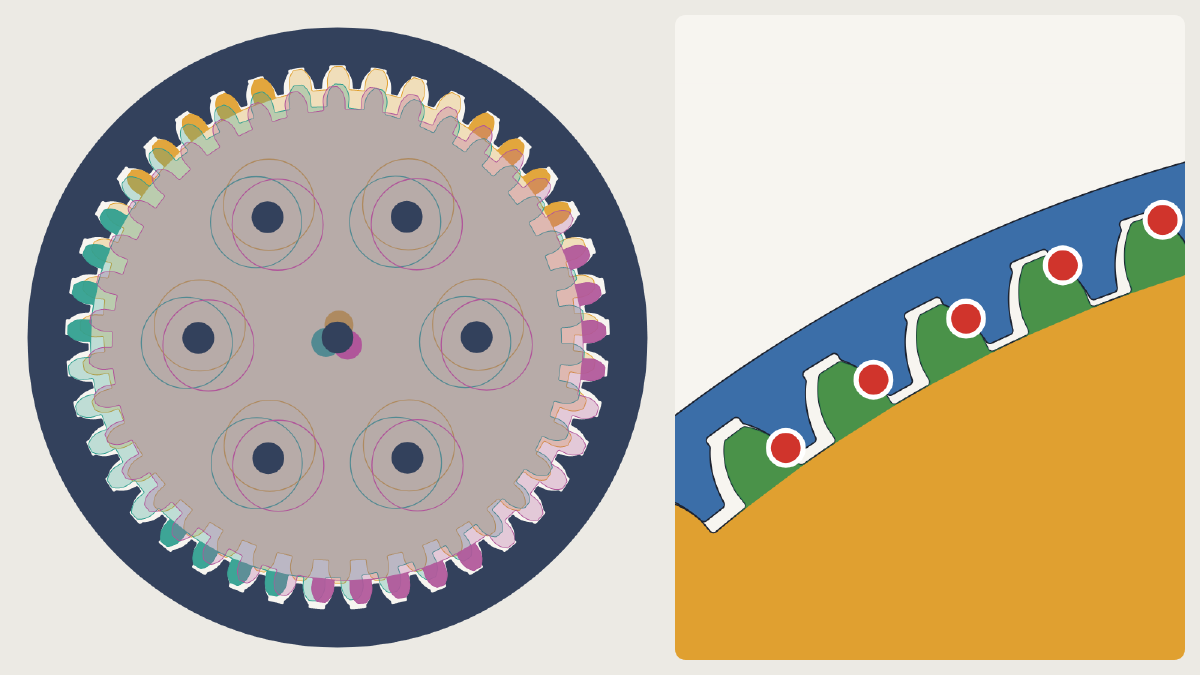

100:1 In One Stage, With Many Teeth Sharing The Load
An internal gear pair whose pinion has just one or two teeth fewer than its ring reduces by about \(Z/d\) in a single, compact stage – 100:1 from a 101/100 pair. With the right tooth form, five to nine teeth share the load at once, and none touch at the line of centres, so there is no tip interference and very little backlash. This is the idea behind Ikona-style gearing, now free of patents.
Dominion R&D derives these tooth forms from first principles in the Open Source package ikona-style, for any tooth count, tooth difference and module. We design low-backlash servos and high-ratio actuators around them: balanced, multi-plate reducers driven by small, fast, low-inertia motors. (PDF, Text)
The Gear Form
A ring of \(Z_1\) teeth meshes with a pinion of \(Z_2=Z_1-d\) teeth, its centre offset by \(e\). Driving the offset (an eccentric) makes the pinion orbit, and the gear turns slowly:
\[ i_{\text{fixed ring}}=\frac{Z_2}{d},\qquad i_{\text{non-rotating pinion}}=\frac{Z_1}{d}. \]
The teeth are not involutes. We choose the path of contact – an Archimedes spiral about the pinion centre, \(\rho(\theta)=a+b\theta\), kept clear of the line of centres – and derive both flanks as its exact conjugates from Willis's condition, which requires every contact normal to pass through the pitch point. Tip fillets, relieved sockets and an undercut-free radial root wall follow from a few shape numbers, each with a known valid range. The result is checked for interference over a full revolution, and contact is measured, for tooth differences of 1 to 4.
| tooth difference \(d\) | 1 | 2 | 3 | 4 |
|---|---|---|---|---|
| teeth in contact per flank, 60 teeth | 6.0 | 4.5 | 3.0 | 2.5 |
| teeth in contact per flank, 80 teeth | 8.5 | 5.5 | 4.5 | 3.5 |
Balanced, Multi-Plate Servos
One orbiting pinion is out of balance, and loads its ring in one place. Two or more pinion plates, orbiting out of phase on shared crankshafts, cancel the shaking force. Stacked as half/full/half plates at 0°/180°/0° ("A-2B-A"), they cancel the rocking couple too, and the ring is loaded evenly at opposite sides.
The plates must be clocked to their phase. Parallel cranks hold every plate at the same orientation, so plate \(k\) of \(N\), with its teeth turned \(\beta_k\) relative to its crank holes, meshes only when
\[ \frac{Z_2\,\beta_k}{2\pi}+\frac{d\,k}{N}\equiv 0 \pmod 1. \]
Get it wrong and the plates collide by most of a tooth. Get it right and the plates can be identical parts, with their meshes staggered for smoother torque. It does constrain the design: plates turned at assembly need a crank count that is a multiple of the number of phases, while a tooth difference divisible by it lets identical plates go in alike, on any number of cranks – eg. a 41/39 pair on five.
Example: An Energy-Recovering Active Damper
Replace a shock absorber with a reversible drive. The stem pulls one of two counter-wound steel bands on a drum. The drum is the reducer's ring, turned backwards to spin a light motor/generator at 20 to 100 times the speed. The controller can then damp, recovering energy; push, as an active suspension; or emulate a spring or an inerter. With drum radius \(r\) and ratio \(N\):
\[ \omega_{motor}=\frac{N v}{r},\qquad T_{motor}=\frac{F r}{N},\qquad b=J\Big(\frac{N}{r}\Big)^2 . \]
The last term is the catch: the motor's inertia appears at the wheel multiplied by \(N^2\). At 102:1 on an 82 mm drum, each \(10^{-6}\,\mathrm{kg\,m^2}\) of rotor feels like 1.5 kg of unsprung mass. A higher ratio does not cure it. A rotor just big enough for the peak force \(F\) adds
\[ b\approx\frac{\rho F^2}{2\pi L\,\eta^2\sigma^2} \]
whatever the ratio, where \(L\) is its length, \(\sigma\) its torque per unit volume, \(\rho\) the density of steel and \(\eta\) the efficiency. The ratio sets only how fast, and how thin, the rotor is. For 2 kN from a rotor 100 mm long at 30 kN·m/m³ (an air-cooled industrial rating), that is about 70 kg – more than the wheel it controls. A shock-absorber replacement therefore wants a long, thin, torque-dense (permanent-magnet) machine, sized for the forces the controller must deliver quickly, with a passive damper in parallel for the peaks and for fail-safety. We work through these trade-offs with you, by modeling and calculation.
Energy-Recovering Inerters (J-Dampers)
Where inertance is wanted, the catch becomes the point. An inerter is a two-terminal element whose force is proportional to the relative acceleration of its ends, \(F=b\,a\); racing suspensions call it a J-damper. A flywheel geared up by \(N\) onto a drum of radius \(r\) is an inerter with \(b=J(N/r)^2\), and an Ikona-style speed increaser makes \(b\) large for very little mass: at 20.5:1 on a 37 mm drum, an 80 by 10 mm steel flywheel gives \(b\approx 99\) kg from about 1 kg of moving parts.
Here a switched-reluctance machine fits well. The inertance makes the force; the machine only damps, recovering energy, or tunes the response, so it can be small. With no magnets, an unexcited machine adds neither drag nor cogging, so the device falls back to a pure inerter. And its plain steel rotor tolerates high speed and heat.
- Vehicles
- Suspension inerters that reduce tyre-load variation; steering and landing-gear shimmy dampers; rail bogies – recovering energy, and adjustable in service.
- Structures
- Tuned inerter dampers for buildings, bridges, stay cables and towers, against earthquake and wind, with little added mass and adaptable tuning.
- Energy
- Wave-energy power take-offs whose inertance tunes the absorber to the sea state.
The limits move to the mechanism. The teeth and bands carry the inertial force: 99 kg at 5 g is 4.9 kN, or 180 N·m on the drum. Backlash and friction distort an inerter, so low-backlash teeth and a band drive matter, and the increaser's losses appear as parasitic damping. The stroke is limited by the band wrap; longer strokes want a rack or a ball screw.
An Experimental 3D Model
A hub of this kind: a 41/39 pair at 20.5:1, half/full/half plates on five crankshafts, the ring as the band drum, and a switched-reluctance machine, with an optional flywheel, on the high-speed shaft. Its teeth come from the ikona-style library. Drag to turn it, switch between shock absorber and J-damper, or open the full model to see its sizing.
Who Benefits
- Robotics and automation
- Compact, low-backlash joint actuators with high torque density, and hollow centres for cabling.
- Automotive
- Active and energy-recovering suspension, inerters (J-dampers), steering and brake actuators.
- Aerospace and defence
- Electromechanical actuators that replace hydraulics.
- Industrial motion
- Servo reducers, positioners and indexers at 30:1 to 200:1 in one stage.
- Mobility and medical
- Hub drives, exoskeletons and prosthetics, where mass and inertia matter.
- Civil and energy
- Tuned inerter dampers for buildings, bridges and towers; wave-energy power take-offs.
What We Offer
- Tooth forms
- Derived profiles for your tooth counts, module, offset and material, delivered as outline data (eg. SVG, DXF) for wire EDM, laser, molding, sintering or additive manufacture.
- Verification
- Interference over a full revolution, contact and clearance analysis, and sensitivity to tolerance and backlash.
- Servo architecture
- Plate count and phasing, crank or pin output, bearings, balance, configuration (fixed ring or fixed pinion), and hollow-centre layouts.
- Drive matching
- Ratio, motor and drive selection, and the reflected-inertia budget; regenerative, four-quadrant operation.
- Control
- Position, torque and impedance control; active damping; energy recovery.
- Prototyping and support
- Design reviews, test planning, and engineering support agreements.
Licensing
ikona-style is available from Dominion R&D Corp. under two licenses: the GNU GPL Version 3 (Open Source), and a Commercial (Closed Source) license.
GNU GPLv3
The GPL allows you to use the software in private scenarios (eg. development, testing and evaluation) free of charge and without obligation. Once you distribute software or devices based on ikona-style, the GPL requires that you provide your users with the source code of your product, and of any changes to ikona-style.
Commercial License
If you wish to keep your product's source code private, a Commercial license authorizes you to develop and deploy products using current and future versions of ikona-style, in whatever form you desire:
Dominion Research & Development Corp. hereby grants to <Your Company> a worldwide, non-revocable, non-exclusive, non-transferable and non-sublicensable Commercial License to use and deploy current and future versions of the ikona-style library, in whatever form they desire.
Ikona is a name used by Ikona Gears for its products; Dominion R&D is not affiliated with Ikona Gears. The tooth forms here are derived independently, from public sources and expired patents.
How To Get Started
See the gear form animate, and change its parameters: the live demo, the explainer and the 3D damper hub. The derivation and the servo design rules are in the ikona-style repository.
git clone https://github.com/pjkundert/ikona-style.git && cd ikona-style
npm test && python3 -m http.server 8080   # then open http://localhost:8080/
Then reach out to Perry Kundert at Dominion R&D Corp. ([email protected]) to discuss your product, a commercial license, and the engineering support that fits.